
Customer Specification Request:
Frekwensiereeks (RF) 3400..3600 MHz
Maximum input power 1 mW (0dBm)
Frekwensiereeks (As) 400..600 MHz
Noise figure @ 18 °C typ. 1.0 dB
Gain @ 25 °C 40 dB
Gain flatness 1.50 dB
Image rejection typ. 47 dB
LO frequency 3000 MHz
LO accuracy @ 18 °C +/- 20 kHz
LO frequency stability +/- 20 kHz
Phase noise @ 100 kHz -112 dBc/Hz
LO leakage to IF port typ. -58 dBm
LO leakage to RF port typ. -52 dBm
Voedingspanning +9 … +18 V GS
Current consumption typ. 180 mA
Operating case temperature range -20 … +55 °C
Input connector / impedance N-female, 50 ohm
Output connector / impedance N-female, 50 ohm
Case milled Aluminium, water resistant
Afmetings (mm) 82 x 64 x 22
gewig 230 g

Analysis of Customer Requirements
This set of parameters clearly describes a C-band to UHF-band frequency down converter, typically used in RF communication, telemetrie, or COFDM video transmission systems. Let’s break down what the customer is looking for and what this specification implies for practical applications.
- Frequency Conversion Purpose:
The input range of 3400–3600 MHz (RF) and output range of 400–600 MHz (As) indicates a fixed Local Oscillator (LO) teen 3000 MHz. This means the converter shifts C-band signals down to a lower IF band, making them compatible with standard COFDM demodulators or SDR receivers. - Low Noise Design:
A 1.0 dB noise figure is exceptional, ensuring minimal signal degradation — crucial for long-range links or weak-signal reception in surveillance, UAV, or broadcast systems. - Stable Gain and Flatness:
Met 40 dB gain and only 1.5 dB flatness, the unit ensures consistent performance across the operating band. This helps maintain a reliable signal-to-noise ratio and simplifies subsequent amplification or demodulation stages. - High Image Rejection:
Die 47 dB image rejection level demonstrates well-designed filtering, which prevents unwanted mirror frequencies from distorting the IF output — a key advantage in narrowband digital systems. - Excellent LO Stability and Phase Noise:
Die ±20 kHz frequency stability en -112 dBc/Hz phase noise at 100 kHz offset show this converter is suitable for modern digital modulation schemes, insluitend COFDM, QPSK, or QAM, where phase noise directly impacts bit error rates. - Robust and Practical Design:
Die milled aluminum, water-resistant housing and wide -20 to +55°C operating range make this converter suitable for field deployment, including mobile command stations, UAV ground control, and outdoor repeater systems. - Power and Interface:
Ondersteunende 9–18 VDC power input and typical 180 mA current draw, it’s compatible with common field power systems. Die N-type 50Ω connectors ensure solid RF performance with minimal signal loss.
Aansoeke
- Long-range COFDM video receiver front-end
- UAV and drone ground control stations
- Wireless surveillance and telemetry
- C-band communication link monitoring
- Military and emergency communication systems
Konklusie
This specification suggests the customer needs a precision-engineered, low-noise RF down converter vir C-band signal reception. It’s ideal for integration into COFDM receiver systems, broadband communication links, or UAV downlink setups where high sensitivity and stability are critical.
Such converters are often paired with high-performance COFDM demodulator modules to provide a complete long-range video or telemetry solution.
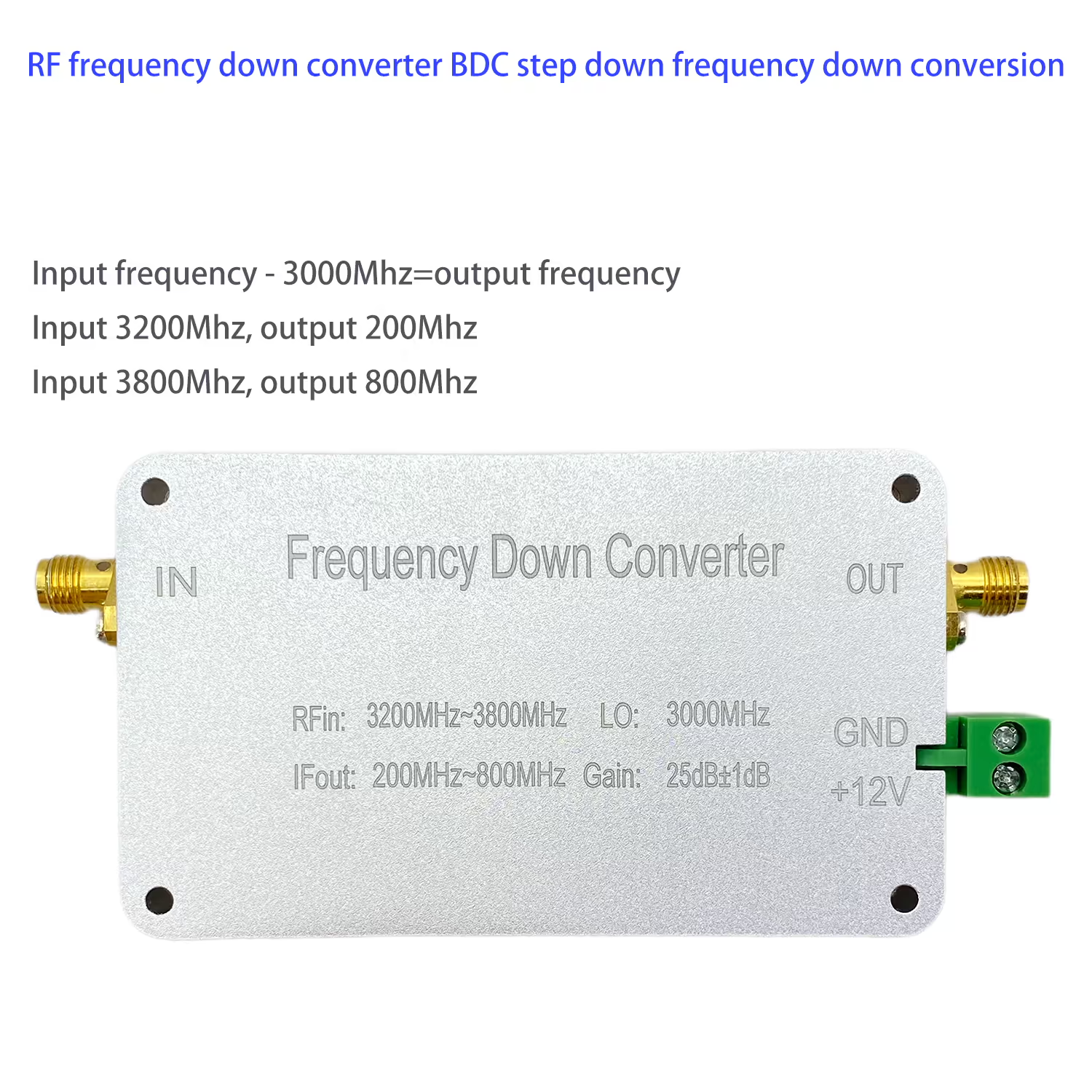
Frekwensie af-omskakelaar
RF-frekwensie-af-omskakelaar BDC Stap frekwensie-omskakeling en omskakeling af
Vrae
V1: What is the purpose of converting 3400–3600 MHz signals to 400–600 MHz?
A1: This down conversion shifts high-frequency C-band signals into a lower IF band, making them easier to process with standard COFDM or SDR demodulators while reducing cost and complexity in the receiver chain.
V2: Can this converter be used with COFDM receivers?
A2: Ja. The 400–600 MHz IF output is ideal for most COFDM demodulator modules, providing compatibility for digital video, telemetrie, or data transmission systems.
V3: How does the 1 dB noise figure affect performance?
A3: A low noise figure ensures minimal degradation of weak RF signals, greatly improving reception quality and effective range — especially important in long-distance UAV and mobile communication links.
V4: Is the converter suitable for outdoor or vehicle-mounted use?
A4: Absoluut. Its water-resistant aluminum enclosure and -20 °C to +55 °C operating range make it reliable for field deployment, including mobile and harsh environments.
Vra 'n Vraag
U boodskap is gestuur