
COFDM Module Experiments
General Conditions
• Two (or three) COFDM modules.
• Bandwidth: 4 MHz wideband.
• Modulation settings:
• FEC: 5/6
• Modulation type: QPSK
• Guard interval: 1/4
• Traffic parameters:
• Protocol: UDP broadcast
• Packet size: 1024 KB
• Transmission rate: 100 packets per second
• Antennas are suitable for the frequency range and in good condition.
• Modules are verified to be functional.
• Multiple frequency configurations tested — the same problem occurs in all cases.
• Typical measured parameters during tests:
• SNR ≈ 25 dB
• RSSI ≈ -25 dBm
• Issue appears only during bidirectional traffic (data sent in both directions simultaneously).
• No packet loss during unidirectional traffic.
Experiment 1
Configuration:
• Module 1:
• TX = 3180 MHz
• RX = 570 MHz
• Module 2:
• TX = 570 MHz
• RX = 180 MHz (via downconverter with 3000 MHz offset)
Result:
• Bidirectional traffic: packet loss observed.
• Unidirectional traffic: no packet loss.
Experiment 2
Configuration (same bandwidth, different frequencies):
• Module 1:
• TX = 800 MHz
• RX = 570 MHz
• Module 2:
• TX = 570 MHz
• RX = 800 MHz
Result:
• Identical to Experiment 1 — packet loss during bidirectional traffic.
• Unidirectional traffic: no packet loss.
Experiment 3
Configuration:
• Two modules from Experiment 1.
• An additional third module configured for RX only at 570 MHz.
Result:
• When the first two modules exchange data bidirectionally, the third RX-only module also experiences packet loss.
• When traffic is unidirectional between the first two modules, no packet loss is observed on any receiver.
Summary of Findings
- Packet loss occurs only during simultaneous bidirectional transmissions.
- Losses also affect independent RX-only receivers operating on the same frequency.
- SNR and RSSI remain within normal ranges during the issue.
- The problem is frequency-independent and occurs with and without frequency downconverters.
please check udp packet size, 1024kb is too long.
COFDM transceiver one-way transmission UDP Experiment 1
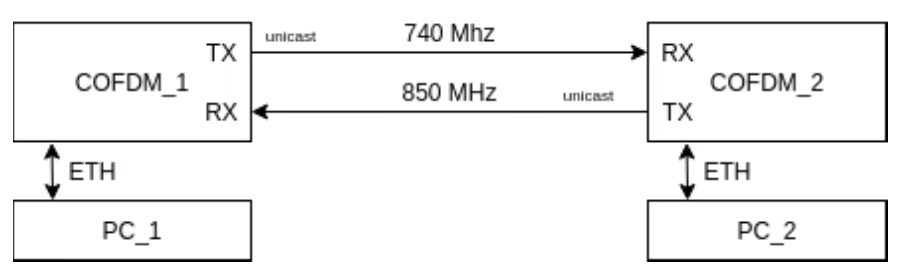
Setup:
● Module 1: RX = 740 MHz, TX = 850 MHz.
● FEC – 1/2
● QPSK
● Guard – 1/32
● Power attenuation – 0
● Bandwidth – 2 MHz
● Data rate = 100 packets/s, each packet 1024 KB.
Test description:
● unicast data was transferred in both directions at the same time
Result:
● When both modules transmitted in both directions at the same time,
packet loss occurred
● When data transfer was one-way only, no packet loss
Setup:
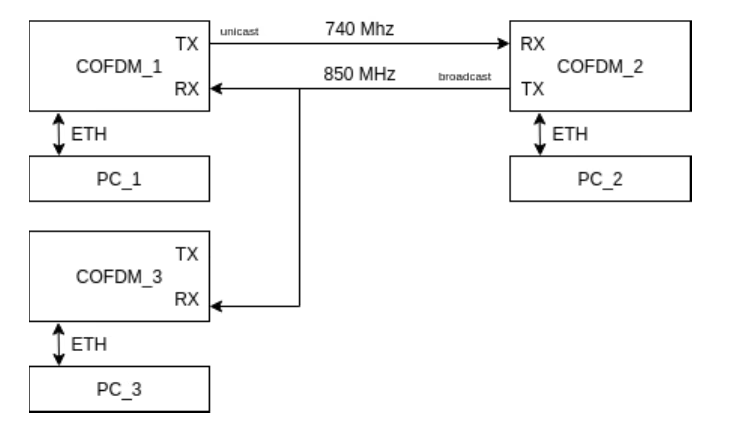
● Three COFDM modules were used
● FEC – 1/2
● QPSK
● Guard – 1/32
● Power attenuation – 0
● Bandwidth – 2 MHz
Test description:
● Module 1 transmitted unicast
● Module 2 transmitted broadcast at the same time as Module 1
● Module 3 only received the broadcast from Module 2
Result:
● With simultaneous unicast and broadcast transmission (Modules 1 and 2
active), Module 3 experienced packet loss while receiving broadcast data
from Module 2
● When only broadcast transmission was active (without concurrent
unicast), Module 3 received data without packet loss
Setup:
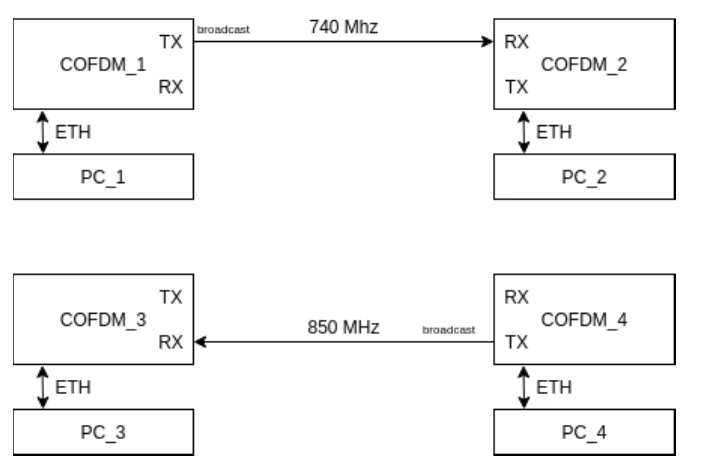
● Four COFDM modules were used.
● Parameters consistent with previous experiments
Experiment description:
● Module 1 transmitted a broadcast to Module 2
● Module 4 transmitted a broadcast to Module 3
● Links were independent, and transmission was at the same time
Observation:
● Both receiving modules (2 and 3) received their data streams without any
packet loss
RESUME: I think we have a hardware problem with the TX part of your
module. When we have TX and RX at the same time, the TX does not transmit
all packets, and we get a packet lost. The problem may be in the bus; you can
not read and write data to your TX and RX submodules at the same time
Ask A Question
Thank you for your response. ✨