
Carbon fiber boards are composite materials made from carbon fiber filaments and resin. The resulting products are lightweight yet strong and durable. There are many different types of carbon fiber boards to suit various applications and industries, including automotive and aerospace. Šiame straipsnyje, we will take a closer look at the uses of carbon fiber boards and their strength compared to other materials.
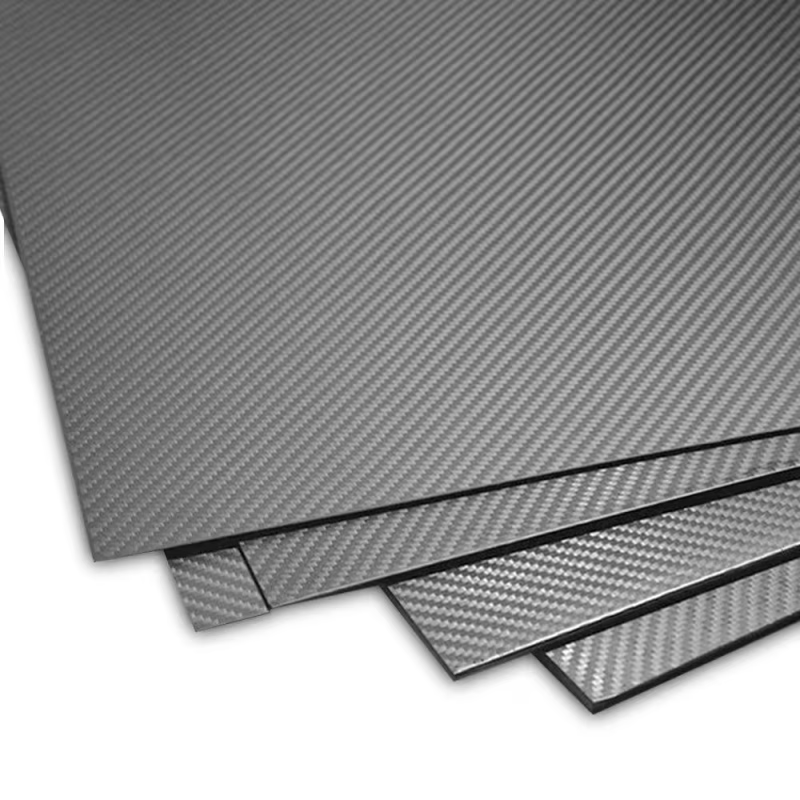
Kur naudojama anglies pluošto plokštė?
Carbon fiber sheets and panels are used in various industries, including automotive, kosmoso, musical instruments, sports equipment, and medical devices.
In the automotive industry, carbon fiber panels can be used to reinforce car components such as doors, hoods, bumpers, fenders, and roof beams. Car manufacturers often use steel to make these parts. Although it is cheaper, steel is much heavier than carbon fiber. To make vehicles like race cars lighter, carbon fiber panels are often used as a replacement for many steel parts.
In the aerospace industry, carbon fiber panels are used to manufacture aircraft components, such as fuselage panels, control surfaces, and wingtips. The resulting components are lightweight yet strong and durable. Carbon fiber is widely adopted in the aviation industry due to its superior strength-to-weight ratio. Be to, because carbon fiber has such an attractive appearance, it is also an ideal choice for aircraft interiors.
Similar to cars, materials such as aluminum and steel are often used in the manufacture of aircraft. Tačiau, commercial airlines are gradually turning to carbon fiber composites to create lighter and stronger aircraft fuselages. This is because carbon fiber is significantly lighter than steel, lighter and stronger than aluminum, and can be formed into any shape.
How strong is carbon fiber board?
There are many properties that are considered when comparing carbon fiber to other materials such as steel and aluminum. Here are just a few:
Modulus of elasticity = The “stiffness” of a material. Stress-strain ratio of a material. The slope of the stress-to-strain curve of a material in its elastic region.
Ultimate tensile strength = The maximum stress a material can withstand before breaking.
Density = The mass per unit volume of a material.
Specific stiffness = Modulus of elasticity divided by the density of a material, used to compare materials with different densities.
Specific tensile strength = Tensile strength divided by the density of a material.
Carbon fiber sheets have a very high strength-to-weight ratio. This means that they are much stronger than other materials of the same weight. Pavyzdžiui, the specific strength of carbon fiber is almost 4 times that of aluminum. This makes carbon fiber sheets an ideal material for a variety of applications where weight is a factor.
While both carbon fiber and steel are very resistant to deformation, steel is 5 times denser than carbon fiber. Carbon fiber has a strength-to-weight ratio that is almost twice that of steel.
Išvada
Apibendrinant, carbon fiber sheet is a versatile composite material with high strength, lightweight, and wide applications. The weight-to-strength of carbon fiber provides significant performance advantages in a variety of industries.
Užduoti klausimą
Jūsų pranešimas išsiųstas