
Achieving Ultra-Low Latency in Composite Analog Video to Network Video Streaming
Encoder Modules Boards
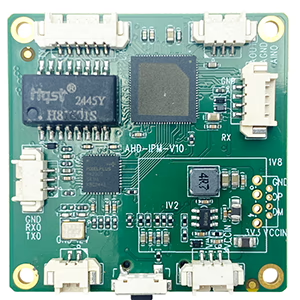
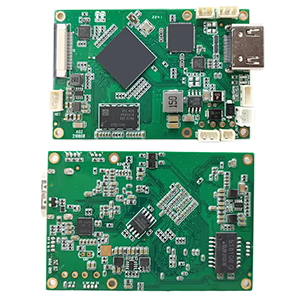
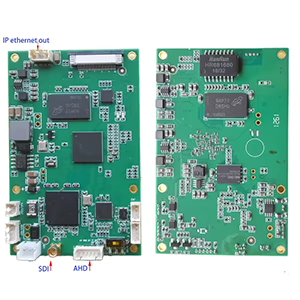
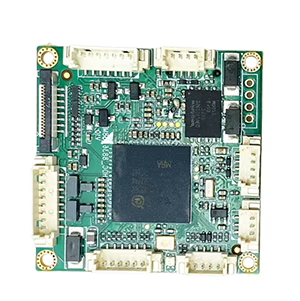

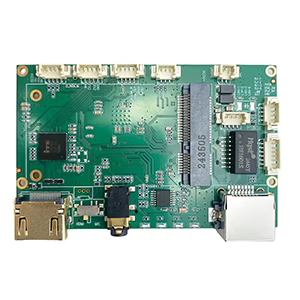
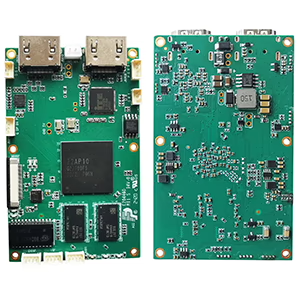
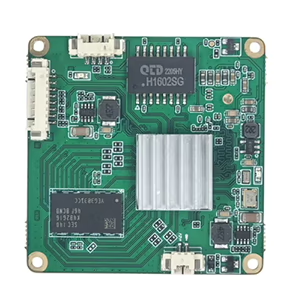
Dekodermodulskort
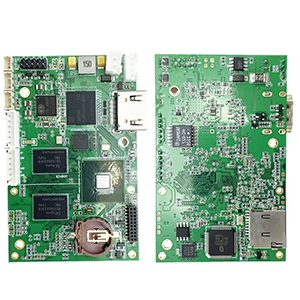

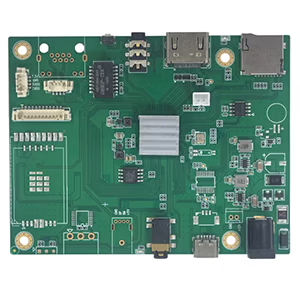
Tillgänglig för anpassning
In the world of Unmanned Aerial Vehicles (UAVS), övervakning, sändning, and industrial inspection, real-time video transmission is mission-critical. Pilots, operators, and analysts rely on fast, stabil, and reliable video feedback to make immediate decisions. A delay of even a few hundred milliseconds can mean the difference between a safe maneuver and a crash, between detecting a threat in time or missing it. This is why achieving ultralåg latens in video systems is essential.
When dealing with composite analog video (CVBS/AV) sources and converting them into network video streams (AV over IP or CVBS to Ethernet video converters), minimizing latency becomes both a technical challenge and a design priority. This article explores how ultra-low latency can be achieved in composite analog-to-IP video streaming systems, why it matters for UAVs, and how specialized hardware and compression techniques make it possible.
1. Why Ultra-Low Latency Matters in UAV Applications
For UAV operations, every millisecond counts:
- Control Responsiveness: Pilots need instant video feedback for navigation, especially in tight spaces, during FPV (Förstapersonsvy) flights, or in military reconnaissance missions.
- Safety: Delayed visuals can result in accidents when UAVs are flying at high speed or near obstacles.
- Data Accuracy: Real-time surveillance and monitoring require synchronization between UAV sensors and live video feeds.
- Mission Efficiency: Whether in agriculture, traffic monitoring, or emergency response, operators must see what the UAV sees without perceptible lag.
This is why composite to IP converters designed for UAVs and mobile video applications focus on latency reduction above all else.
2. The Challenge of Latency in Analog-to-IP Conversion
Composite analog video (CVBS/AV) is inherently low-latency in its raw electrical signal form. Dock, the process of digitizing, compressing, transmitting, and decoding introduces delays.
Sources of Latency:
- Analog-to-Digital Conversion (ADC): Digitizing analog signals.
- Compression: Encoding video into digital formats such as H.264 or H.265.
- Buffering: Required for error correction and packet handling in IP networks.
- Överföring: Over wired Ethernet, Wi-fi, or COFDM wireless links.
- Decoding: Converting digital stream back into viewable video.
Each of these stages contributes milliseconds of delay. While consumer-grade systems may tolerate 500–1000 ms delays, UAV-grade systems target nedan 100 Fröken, and in advanced setups, så låg som 30 Fröken.
3. Key Technologies Enabling Ultra-Low Latency
(a) Efficient Video Codecs
- H.264 (Stroke): Widely used, effektiv, but adds some delay due to compression complexity.
- H.265 (HEVC): Offers higher compression efficiency, reducing required bandwidth. Advanced hardware-accelerated H.265 encoders can achieve sub-50 ms latency.
- MJPEG (Rörelse JPEG): Nearly zero compression latency but requires very high bandwidth.
For UAV and composite video applications, hardware-based H.265 encoding offers the best balance of compression and latency.
(b) Hardware Encoders and Decoders
General-purpose processors introduce significant delay. Dedicated hardware such as FPGA or ASIC-based video encoders can process signals in real-time, cutting delays to milliseconds.
(c) COFDM Transmission
For wireless UAV video, COFDM (Coded Orthogonal Frequency Division Multiplexing) ensures robust transmission with minimal delay, even in environments with multipath interference.
(d) Adaptiv bitrate
By dynamically adjusting bitrate to network conditions, adaptive streaming avoids buffering delays.
(e) Low-Latency Protocols
- RTP/UDP: Faster than TCP since it avoids retransmission delays.
- SRT (Secure Reliable Transport): Provides low-latency streaming with error correction.
- Custom proprietary protocols: Many UAV systems use optimized protocols for minimal buffering.
4. Design Considerations for Ultra-Low Latency CVBS-to-IP Converters
To achieve ultra-low latency, converters must address the entire pipeline:
- Fast Analog-to-Digital Conversion:
- Use high-speed ADC chips optimized for composite video.
- Minimize preprocessing steps.
- Hardware Compression:
- FPGA-based H.265 encoding with ultra-low latency mode.
- Select GOP (Group of Pictures) structure carefully — shorter GOP reduces delay.
- Optimized Networking:
- Prioritize RTP/UDP over TCP.
- Use Ethernet or COFDM wireless modules tuned for video.
- Decoding Efficiency:
- Hardware decoders on ground receivers (FPGA/ASIC).
- Low buffer depth.
- System Integration:
- Ensure uplink (kontrollera) och nedlänta (video-) are separated to avoid interference.
- Shield converters from RF noise in UAV environments.
5. Case Example: UAV Composite Video to IP Streaming
Consider a UAV equipped with a standard analog camera outputting CVBS video. To transmit this over long distances:
- The video is fed into a Composite CVBS to IP Converter.
- The converter digitizes the signal, encodes it using hardware H.265, and streams it over Ethernet.
- A COFDM transmitter sends the stream wirelessly to the ground station.
- On the ground, a hardware decoder instantly reconstructs the video for the operator.
With optimized hardware, total fördröjning från slut till ände kan reduceras till 30–50 ms.
Example Solution from Industry:
Companies like isdb-t.com offer AV to IP COFDM modules that achieve ultra-low latency for UAV use. These systems are engineered with:
- Hardware-accelerated H.265 encoding.
- Narrowband uplink + broadband downlink separation.
- Modular HDMI/AV/SDI input options.
By integrating such converters, UAVs can deliver reliable, real-time composite video streaming even in interference-heavy environments.
6. Importance Beyond UAVs
While UAVs demand the strictest latency standards, other industries also benefit:
- Sändning: Live event coverage with analog cameras requires instant streaming.
- Medical Imaging: Remote surgeries need zero-delay video feeds.
- Security Systems: Real-time monitoring for safety-critical infrastructure.
- Industrial Robotics: Operators require immediate visual feedback during teleoperation.
In all these cases, composite AV-to-IP ultra-low latency converters ensure safe and efficient operation.
7. Future Trends in Ultra-Low Latency AV-over-IP
- 5G and Private Networks: Leveraging ultra-reliable low-latency communication (URLLC) for even faster UAV video streaming.
- AI-Enhanced Encoding: Intelligent encoders that allocate resources dynamically to reduce latency.
- Edge Processing: Onboard UAV systems that preprocess video before transmission.
- Multi-Link Redundancy: Using multiple frequencies and links (TILL EXEMPEL., 2.4 GHz + 5.8 GHz) to ensure uninterrupted low-latency video.
Slutsats
Framförande ultralåg latens in composite video to IP streaming requires a holistic approach: fast digitization, hardware-based encoding, low-latency protocols, and optimized wireless transmission. For UAV applications, where reaction speed is critical, converters like CVBS to Ethernet/IP video converters eller AV-over-IP solutions play a central role. By leveraging technologies such as H.265 compression, COFDM-modulering, and dedicated hardware encoders, modern UAVs can achieve delays as low as 30 ms — essentially providing real-time video.
As UAV technology continues to expand into industrial, commercial, and defense sectors, the demand for pålitlig, ultra-low latency AV-to-IP converters will only grow. Companies like isdb-t.com are pushing the boundaries of what’s possible, ensuring UAVs deliver not just video, but video at the speed of thought.
Ställa en fråga
Tack för din respons. ✨