
Encoder Modules Boards
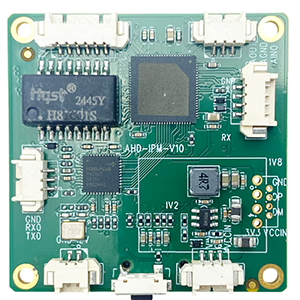
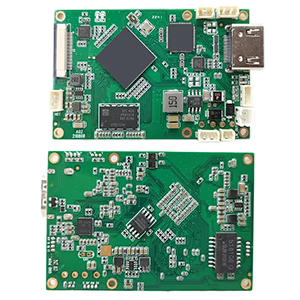
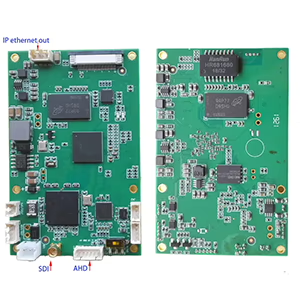
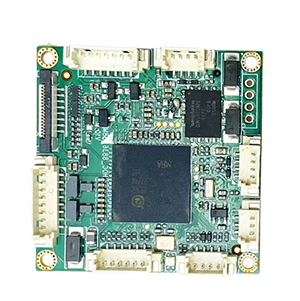

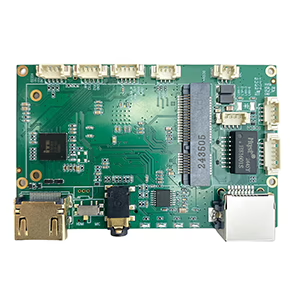
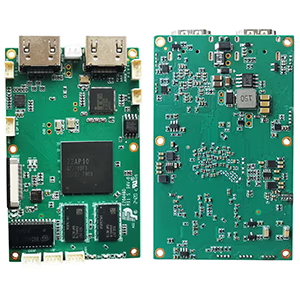
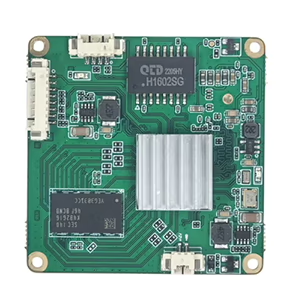
Decoder Modules Boards
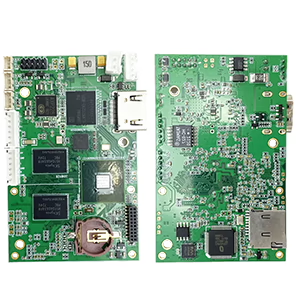

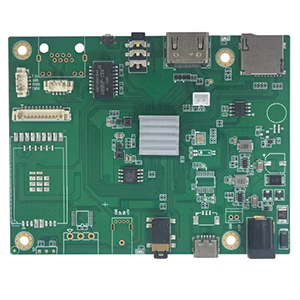
Available for Customization
I am in the process of finding a solution that will allow me to convert analog video signals from CVBS and AHD cameras, with a primary focus on AHD, into an IP-based format for network transmission and digital recording. Are you able to provide similar support as well?
Insette
- The video quality options include AHD 720p and AHD 1080p at 30 frames per second.
- CVBS (NTSC)
Uitset
The IP camera supports RTSP streaming with both MJPEG and H264 compression capabilities.
Antwoord:
Thanks for your inquiry about AHD to IP converter. We have two types products meets your demand. The difference is on the latency.
Model 2090
Model 1731 (lower latency and support two video stream, CVBS + AHD)
In some cases, drones and robots require extremely low latency, while other applications are unaffected by 100ms delays.
A video encoder that converts CVBS (Composite Video Baseband Signal) and AHD (Analoog hoë definisie) to IP (Internet Protocol) is a device designed to bridge analog and digital video systems by transforming analog signals into network-transmissible digital streams. Here’s a structured breakdown:
Sleutelkomponente & Functionality
- Input Handling:
- CVBS: Supports standard-definition analog signals (Bv., 480i/576i) via RCA or BNC connectors.
- AHD: Processes high-definition analog signals (Bv., 720bl, 1080bl) over coaxial cables, preserving HD quality during conversion.
- Conversion Process:
- Digitization: Uses an Analog-to-Digital Converter (ADC) to transform analog signals into digital data.
- Compression: Applies codecs like H.264/H.265 to reduce file size while maintaining quality, optimizing bandwidth usage.
- Packaging: Encapsulates data into IP-friendly formats (Bv., RTSP, RTP) for network transmission.
- Uitset:
- Transmits via Ethernet, enabling integration into IP networks. May support Power over Ethernet (PoE) for simplified power and data delivery.
Aansoeke
- Legacy System Modernization: Integrates older analog CCTV cameras (CVBS/AHD) into IP-based surveillance systems without replacing existing infrastructure.
- Hybrid Surveillance: Allows simultaneous use of analog and IP cameras, ideal for phased upgrades.
- Remote Access: Facilitates cloud storage, live streaming, and remote monitoring via networked devices.
Kenmerke
- Multi-Channel Support: Some encoders handle multiple inputs (Bv., 4-channel models) for scalability.
- Configuration Flexibility: Web-based interfaces for adjusting resolution, bitrate, and frame rate.
- Verenigbaarheid: Often supports ONVIF standards to ensure interoperability with Network Video Recorders (NVR's) and software.
Considerations
- Vertraging: Encoding may introduce slight delays, critical for real-time applications.
- Bandwidth Management: Adjustable compression settings balance video quality and network load.
- Hardewarevereistes: Ensure network infrastructure (Bv., switches, routers) can handle increased IP traffic.
Example Use Case
A security system with existing AHD cameras (1080bl) and CVBS cameras can use an encoder to stream footage over a network. The encoder digitizes and compresses the signals, allowing integration with an NVR for centralized management and access via smartphones or PCs.
About MJPEG
MJPEG (Beweging JPEG) is a video compression format where each individual frame is compressed as a standalone JPEG image. Unlike modern codecs (Bv., H.264, MPEG), it does not useinter-frame compression (temporal compression), resulting in unique advantages and limitations.
Belangrike kenmerke
- Frame Independence: Each frame is a complete JPEG image, making it:
- Simple to process (low computational overhead).
- Lae latensie (ideal for real-time applications like surveillance or medical imaging).
- Easy to edit (individual frames can be extracted without decoding adjacent frames).
- Verenigbaarheid: Widely supported due to JPEG’s ubiquity. Works with most devices, browsers, and software.
- Quality: Maintains consistent per-frame quality, useful for applications requiring frame accuracy (Bv., video editing, frame-by-frame analysis).
Voordele
- Lae latensie: Suitable for live previews or real-time systems.
- Hardware-friendly: Easy to encode/decode with minimal processing power.
- Frame accuracy: No motion blur artifacts from inter-frame compression.
Disadvantages
- Large File Sizes: No temporal compression means higher storage/bandwidth requirements.
- Inefficient for Long Videos: Less optimal than modern codecs (Bv., H.265) for streaming or archival.
- Limited Features: No support for modern features like dynamic bitrate adjustment or HDR.
Common Use Cases
- Surveillance Systems: Low latency and frame accuracy for real-time monitoring.
- Medical Imaging: Frame independence ensures no data loss between critical frames.
- Legacy Devices/Cameras: Digital cameras, webcams, or drones where simplicity is key.
- Video Editing: Frame-level access simplifies post-production workflows.
Technical Notes
- Color Subsampling: Typically uses JPEG’s 4:2:0 chroma subsampling.
- Variants: MJPEG2000 (uses wavelet compression) offers better quality but lacks broad compatibility.
- Container Formats: Often wrapped in AVI, MOV, or multimedia transport streams.
Comparison to Modern Codecs
| Funksie | MJPEG | MPEG/H.264/H.265 |
|---|---|---|
| Compression Efficiency | Laag (intra-frame only) | High (inter-frame + intra) |
| Vertraging | Very low | Moderate to high |
| Editing Flexibility | High (frame independence) | Lower (GOP dependencies) |
| Bandwidth Use | High | Geoptimaliseer |
When to Use MJPEG?
- Prioritizelae latensie over file size.
- Requireframe-by-frame access for editing/analysis.
- Work with legacy systems or hardware with limited processing power.
For streaming or storage efficiency, modern codecs (Bv., H.265, VP9) are typically better choices.
Vra 'n Vraag
U boodskap is gestuur