
How TDD OFDM Bidirectional Links Solve High-Rate Telemetry and Sensor Data Challenges in Drone Communication
Introduction
Modern UAVs (Unmanned Aerial Vehicles) increasingly demand simultaneous transmission of multiple data types—telemetry, high-rate sensor or video data, and command/control feedback. Achieving all of these over a reliable and low-latency wireless link is not a trivial task, especially when dealing with real-time applications such as surveillance, mapping, or autonomous navigation.
A customer recently presented the following requirements for a drone communication system:
Customer’s Requirement Summary:
- Sending telemetry data @40ms (40KB data) over a 100 Mbps Ethernet line. Data is sent as UDP packets.
- Sending raw data of size 1.7 MB @40ms over a 1 Gbps Ethernet line using UDP protocol.
- Command/response over RS422, to interact with the drone’s onboard computer to get IMU data (location and attitude) @40ms, and also interact with GCS over RF.
This set of requirements highlights the complexity of modern UAV data transmission needs: high throughput, low latency, and full-duplex interaction between air and ground.
Challenges in the Original Setup
Let’s analyze the requirements in technical terms:
| Data Type | Interval | Data Size | Equivalent Data Rate | Communication Type |
|---|---|---|---|---|
| Telemetry | 40 ms | 40 KB | ~8 Mbps | UDP (100 Mbps Ethernet) |
| Raw Data | 40 ms | 1.7 MB | ~340 Mbps | UDP (1 Gbps Ethernet) |
| Command / IMU | 40 ms | <100 KB | Negligible | RS422 serial link |
Key challenges:
- Throughput: 340 Mbps of raw data exceeds what traditional COFDM or narrowband systems can handle.
- Directionality: Telemetry and IMU data must flow in both directions between the drone and GCS.
- Synchronization: Data, video, and control links need to be synchronized at 25 Hz (40 ms period) without packet loss or high latency.
This makes it evident that a TDD (Time Division Duplex) OFDM-based bidirectional link is the ideal solution.
Why TDD OFDM is the Right Solution
1. Bidirectional Transmission in a Single Frequency Channel
Unlike traditional unidirectional COFDM transmitters, a TDD OFDM link uses the same frequency band for both uplink and downlink, alternating transmission time slots. This allows:
- Full bidirectional communication (command, telemetry, and data)
- Reduced RF complexity and antenna requirements
- Perfect synchronization between drone and ground station
2. Efficient Spectrum Use
In narrowband environments or frequency-constrained UAV systems (e.g., 300 MHz–6 GHz), TDD OFDM allows adaptive allocation of uplink/downlink ratios:
- For example, 80% downlink for sensor/video data and 20% uplink for telemetry/commands.
- Dynamic switching based on link condition ensures optimal throughput and minimal delay.
3. UDP Compatibility
Since UDP is lightweight and real-time friendly, the TDD OFDM system can encapsulate UDP packets directly in its Ethernet bridge mode, ensuring transparent data transmission for both telemetry and sensor data.
4. Integration with RS422 / Serial Control
TDD OFDM modules often support transparent serial data (RS232/422/485) channels in parallel with the Ethernet stream. This allows:
- Real-time command/control exchange with the onboard computer
- IMU and GPS data synchronization with ground control software
- Unified data stream combining Ethernet and serial interfaces
5. Low Latency and Stability
With optimized framing, TDD OFDM systems can achieve end-to-end latency under 40–50 ms, which meets the customer’s requirement of 25 Hz telemetry update rate.
Additionally, the robust FEC (Forward Error Correction) and adaptive modulation maintain stable transmission even under dynamic flight conditions.
System Implementation Example
[Drone Onboard Unit]
 ├── Sensors / Camera (Raw Data 1.7 MB @40ms)
 ├── Flight Controller (Telemetry + IMU via RS422)
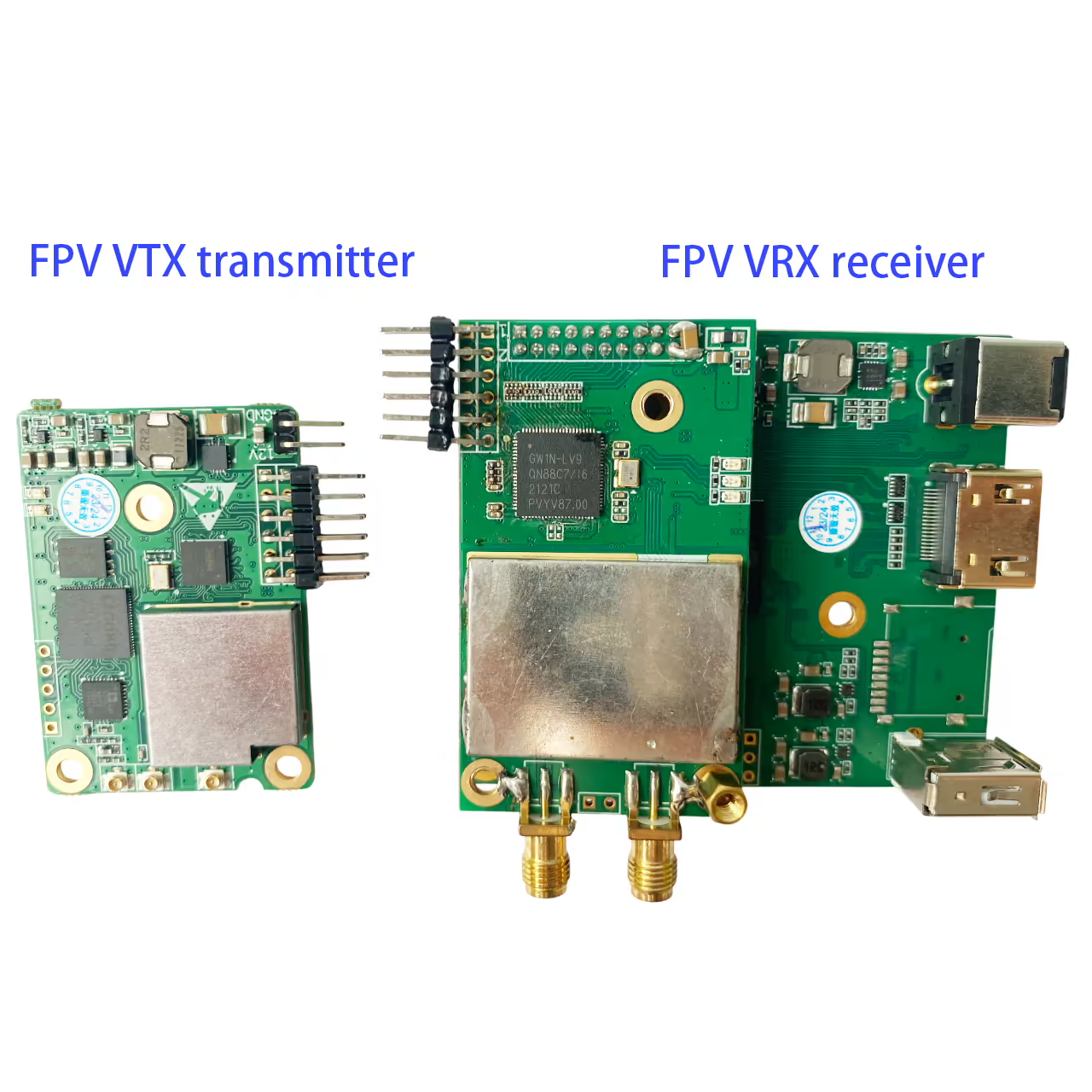
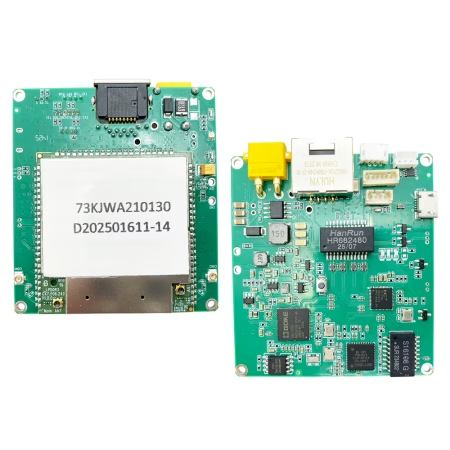
 ├── TDD OFDM Transceiver Module (Ethernet + Serial Input)
 └── Power & Antenna System

       ⇅  (Bidirectional RF Link, e.g., 840 MHz / 1.4 GHz / 2.4 GHz)

[Ground Control Station]
 ├── TDD OFDM Receiver (Ethernet Output + RS422)
 ├── GCS Software (UDP-based Telemetry & Control)
 └── Data Storage / Video Processing System
This configuration enables a full-duplex data bridge between the drone and the ground—video, telemetry, and serial control signals all flow seamlessly through the same TDD OFDM radio link.
Advantages of TDD OFDM Bidirectional Links
| Feature | Benefit |
|---|---|
| Single Frequency for TX/RX | Simplifies antenna setup and spectrum licensing |
| Adjustable Time Slot Ratio | Customizable for uplink/downlink bandwidth balance |
| Transparent UDP / Ethernet Support | Directly compatible with existing IP-based systems |
| Integrated Serial Port | Ideal for command/control and telemetry exchange |
| Low Latency | <50 ms end-to-end delay |
| Strong Anti-Interference | OFDM modulation and FEC ensure stable performance |
Conclusion
The customer’s demanding setup—combining telemetry, raw data, and RS422 control—illustrates why modern UAV systems require adaptive, full-duplex data solutions.
A TDD OFDM bidirectional link provides:
- Real-time, two-way Ethernet and serial communication
- Scalable throughput for both compressed and raw data
- Reliable synchronization at 40 ms update intervals
By deploying a TDD OFDM system, UAV designers can achieve the perfect balance of throughput, latency, and reliability, making it the backbone of next-generation drone communication networks.
FAQ
Q1: Can a TDD OFDM link handle both video and telemetry at the same time?
Yes. The system supports Ethernet bridging, allowing multiple data streams—video, telemetry, and control—to be multiplexed simultaneously.
Q2: What is the typical latency of a TDD OFDM link?
Depending on the configuration and modulation, system latency is typically 30–50 ms, suitable for UAV real-time control and HD video transmission.
Q3: How does it differ from a traditional COFDM transmitter?
Traditional COFDM systems are one-way (TX only), while TDD OFDM is bidirectional, supporting both data and command channels in one frequency band.
Q4: Is 1.7 MB @40ms feasible over RF?
Not directly. The uncompressed data rate (340 Mbps) is too high for typical COFDM or TDD OFDM links. The solution is to compress, downsample, or selectively transmit critical data portions.
Q5: What interfaces are supported?
TDD OFDM modules usually include:
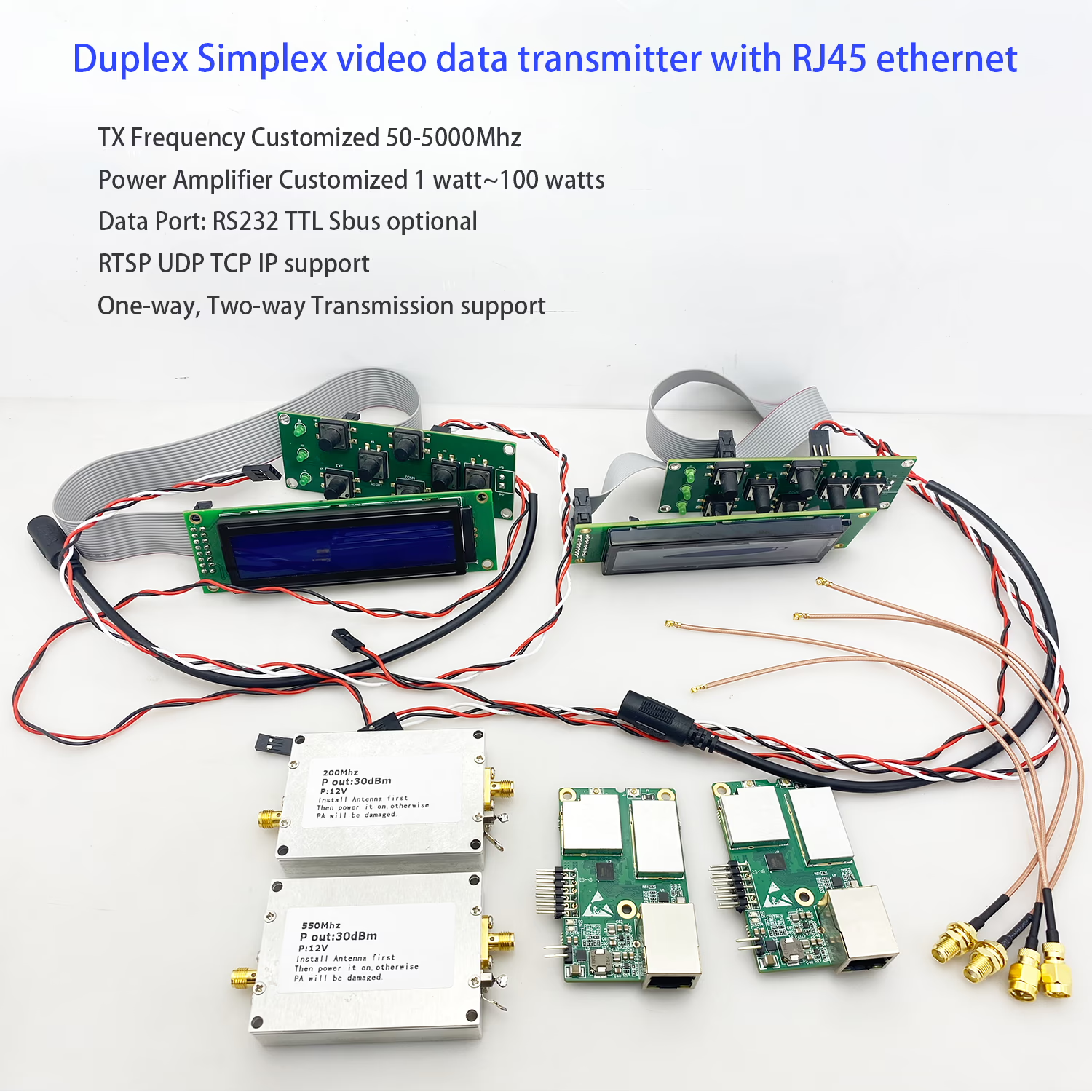
Ethernet (10/100/1000 Mbps) for UDP/TCP/IP communication
Serial port (RS232/422/485) for command or telemetry exchange
GPIO or CAN (optional) for external device control


Drone Video Data Link
VTX for drone video data link long-range transmitter receiver 30-50km 2X1.6WPA

HDMI Encoder to ISDB-T RF

Drone Video Data Link
Drone Video Data Link
Drone Video Data Link
Ask A Question
Thank you for your response. ✨