
CBR проти VBR у бездротовій передачі відео: Why Vcan1746 Uses Constant Bitrate
When it comes to video encoding for wireless transmission, two common modes are CBR (Constant Bitrate) і VBR (Variable Bitrate). Both aim to balance video quality and bandwidth usage, but they behave quite differently — especially in real-time wireless applications like drones, COFDM transmitters, or portable video links.
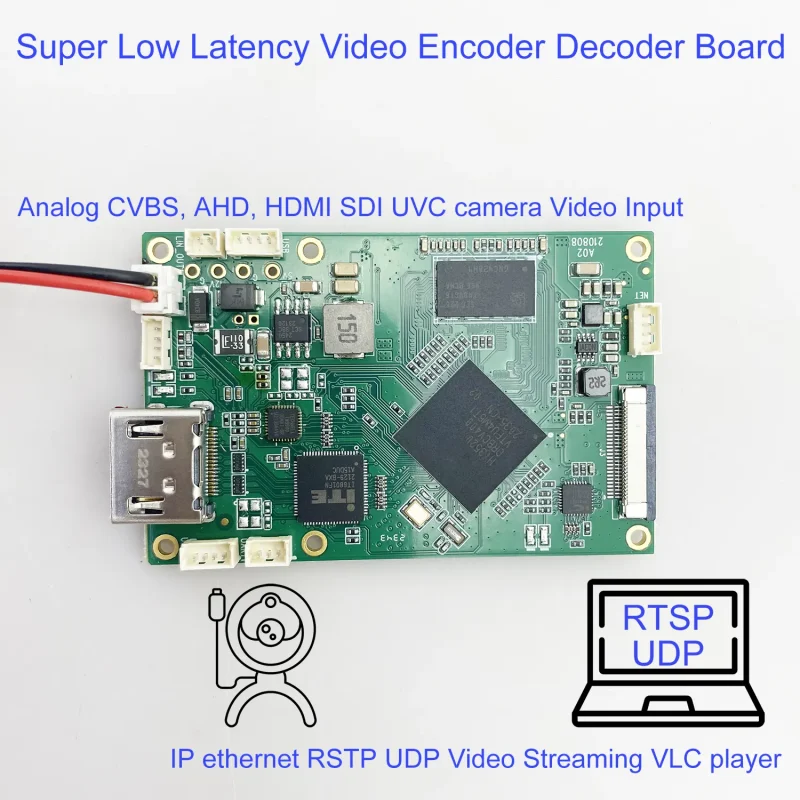
The Vcan1746 COFDM encoder currently supports CBR only, and for good reason. Let’s explore why.
Understanding CBR (Constant Bitrate)
Constant Bitrate means the encoder maintains a fixed data rate throughout the transmission.
- The video stream always uses the same bandwidth, even when the scene becomes more complex.
- This ensures stable transmission, predictable network load, and consistent latency.
Advantages of CBR:
- Very stable for wireless links with limited bandwidth.
- Predictable delay, ideal for real-time applications (напр. дрони, спостереження).
- Simpler for COFDM or TDD systems to handle.
Недоліки:
- May waste some bandwidth when the scene is simple (напр. static images).
- Slightly lower efficiency compared to VBR in offline video recording.
Understanding VBR (Variable Bitrate)
Variable Bitrate encoding adjusts the bitrate dynamically depending on the complexity of each frame or scene.
- Complex motion or detail results in higher bitrate.
- Simple scenes are encoded at lower bitrate, saving space.
Advantages of VBR:
- Higher average image quality at the same average bitrate.
- More efficient for storage applications like DVRs or file-based recording.
Недоліки:
- Unpredictable bandwidth usage — peaks may exceed link capacity.
- Can cause frame loss or buffering over wireless links.
- Harder to maintain ultra-low latency transmission.
Why the Vcan1746 Uses CBR
Wireless video systems like the Vcan1746 are designed for в реальному часі, low-latency COFDM transmission. The radio bandwidth is limited and cannot easily adapt to sudden bitrate spikes caused by VBR.
In other words:
- CBR keeps the transmission stable and predictable.
- VBR is better for recording or offline streaming, not live wireless.
If VBR were used in a narrowband RF link, the encoder might occasionally exceed the available bandwidth, causing data packet loss, image stutter, or link dropouts. тому, CBR is the only practical and reliable option in such real-time transmission systems.
Typical Use Cases
| Режим | Best Used For | опис |
|---|---|---|
| CBR | Live wireless transmission | Stable, constant bitrate ensures reliable real-time performance. |
| VBR | Local recording / playback | Adaptive bitrate optimizes quality and storage efficiency. |
FAQ
Q1: Can I enable VBR mode on the Vcan1746?
В даний час, the Vcan1746 supports only CBR mode to ensure stable performance on limited wireless bandwidth.
Q2: Why not just increase the bandwidth for VBR?
Most COFDM wireless systems have fixed RF channel bandwidths (напр., 2МГц, 4МГц, 8МГц). Increasing the bitrate beyond that causes signal distortion or loss.
Q3: Would VBR improve image quality?
In theory, yes — but only if the transmission link can handle fluctuating bitrate. For wireless real-time use, stability is more critical than marginal quality gain.
Q4: Is VBR supported in recording mode?
так, VBR is often used for local storage (напр., DVR, SD card, or NVR), where temporary bitrate spikes do not affect transmission stability.
Висновок
для wireless video transmission, стабільність, затримка, and bandwidth predictability are key. Поки VBR provides higher efficiency for stored media, CBR remains the standard for real-time COFDM or TDD transmission, ensuring reliable and uninterrupted video.
That’s why the Vcan1746 — and most professional wireless video modules — operate in CBR mode only.
Кодер HDMI до ISDB-T RF
Задайте питання
Дякуємо за вашу відповідь. ✨