
Objetivo do Projeto
Operações ferroviárias, particularmente durante manobras de marcha-atrás, são propensos a riscos de segurança devido à visibilidade limitada e ao potencial de colisões. Este projeto propõe o desenvolvimento de um dispositivo de segurança avançado que melhore a consciência situacional e evite acidentes durante a marcha-atrás de vagões ou truques ferroviários.
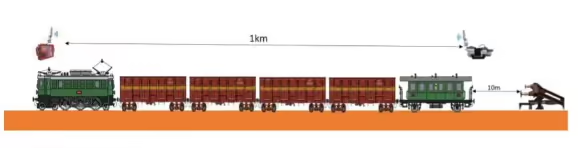
Visão geral do projeto
O dispositivo de segurança proposto será instalado em cada vagão/bogie e fornecerá alertas em tempo real ao maquinista da locomotiva durante a marcha-atrás. O sistema evitará colisões detectando obstruções, incluindo batentes de via, dentro de um intervalo predefinido de 10 metros da traseira do último vagão. Adicionalmente, o processo de reversão será monitorado através de câmeras IP com transmissão ao vivo para um display portátil.
Principais recursos
- Sistema de detecção de colisão: Detecte travamentos nas extremidades dos trilhos e outras obstruções em um alcance de 10 metros. Fornece alertas graduados conforme o bogie se aproxima da obstrução.
- Sistema de alerta em tempo real: Os alertas são transmitidos diretamente ao maquinista da locomotiva. Os alertas aumentam de urgência à medida que o bogie se aproxima do obstáculo detectado.
- Monitoramento de vídeo ao vivo: Câmeras IP de alta resolução fornecem transmissão de vídeo em tempo real. Transmissão sem fio de transmissão ao vivo para um monitor portátil para maior visibilidade.
- Sistema de exibição portátil: O maquinista da locomotiva recebe imagens ao vivo por meio de uma rede segura. Interface amigável para monitoramento e alertas.
- A câmera e o display portátil funcionam com bateria de até 4 horas de backup. Será fornecido um carregador para recarga.
Pilha de tecnologia
- Sensores: Detecção baseada em LiDAR para detecção precisa de obstruções.
- Protocolo de comunicação: Transmissão sem fio usando tecnologias baseadas em RF
- Transmissão ao vivo: Câmeras integradas com transmissão baseada em rede RF.
- Sistema de exibição: Display portátil com conexão segura para receber feeds em tempo real.
- Sistema de Alerta: Alertas audiovisuais para o maquinista da locomotiva.
Benefícios
- Segurança aprimorada: Minimiza o risco de colisões durante operações de reversão.
- Visibilidade aprimorada: O monitoramento ao vivo melhora a consciência situacional.
- Eficiência nas Operações: Reduz atrasos e acidentes, melhorando a eficiência ferroviária.
Plano de Implementação
- Fase 1: Teste piloto
- Instale protótipo em truques ferroviários selecionados para testes ao vivo.
- Colete feedback e otimize o sistema.
- Fase 2: Implantação& Expansão
- Implantação em larga escala em redes ferroviárias.
Especificações Técnicas
Características de transmissão
- Modulação: COFDM
- Tipo de modulação: QPSK (4Controle de qualidade),16Controle de qualidade, 64Controle de qualidade
- Frequência de trabalho: 433MHz
- Largura de banda RF: 2MHz
- Recebendo Sensibilidade:-106dBm @ 1,25 MHz
Características dos dados
- Saída de vídeo: DE(CVBS)
- Criptografia:AES128 ou AES256
- Tamanho da tela: 10.1 polegada
Características Elétricas
- Tensão de trabalho: DC12V ou bateria
- Corrente de trabalho: <2.5UM
- Bateria:12.6V/4,5Ah
O cliente solicitou uma largura de banda de 2M. Nosso FPV1887 pode atingir largura de banda de 2M. Quando o sinal está fraco, 2A largura de banda M pode transmitir mais longe e tem maior capacidade de difração. Se precisa ser mais barato, então só podemos alcançar 6M de largura de banda, qual é o nosso COFDM-912T.
A distância de transmissão mencionada em nossa tabela de preços refere-se à transmissão dentro da linha de visão do drone aéreo para a estação de controle terrestre. Quanto maior for a diferença de altura entre o transmissor e o receptor, mais forte o sinal de transmissão. Porque este projeto é usado em um trem, a distância de transmissão será bastante reduzida. Recomenda-se usar um amplificador de 3W ou 5W.
O projeto exige que o radar reverso tenha um alcance de detecção de cerca de 10 metros. Aqui, radar de ondas milimétricas deve ser usado. O alcance de detecção do radar reverso de carros comuns é de apenas dois a três metros.
O projeto de transmissão de vídeo sem fio de reversão do trem mencionou que baterias e monitores são necessários. Recomenda-se que os usuários os comprem localmente de acordo com o local real de instalação e o mercado de uso. Nós não os fornecemos.
Então o receptor está do lado do maquinista, e também temos que saber a altura da antena e a altura permitida de instalação. Por exemplo, é uma antena receptora de 1.2 medidores autorizados a serem instalados no topo da locomotiva. Se a parte superior da locomotiva não puder ser instalada, pode ser instalado em ambos os lados da cabine? Qual é a faixa de comprimento das antenas que podem ser instaladas em ambos os lados? Por exemplo, um metro ou 1.5 metros. Quanto mais longa a antena, quanto maior o alcance de transmissão. Podemos fazer um orçamento primeiro para o cliente e depois estender a antena se ocorrer distância de transmissão ou interferência.
Também podemos usar a antena direcional e a antena omnidirecional. Uma antena direcional tem o dobro da intensidade do sinal de uma antena omnidirecional. É melhor comprar as duas antenas. Bem, ajuste-os de acordo com a instalação real e os resultados dos testes.
Nossos transmissores e receptores de vídeo sem fio existentes só podem transmitir vídeo. O engenheiro precisa fazer uma modificação especial para você adicionar a transmissão do sinal do radar reverso para 10 metros.
Faça uma pergunta
Sua mensagem foi enviada