
Aim of the Project
Railway operations, particularly during reversing maneuvers, are prone to safety hazards because of limited visibility and the potential for collisions. This project proposes the development of an advanced safety device that enhances situational awareness and prevents accidents while reversing railway wagons or bogies.
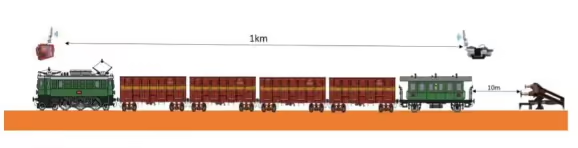
Project Overview
The proposed safety device will be installed on each wagon/bogie and will provide real-time alerts to the locomotive driver when reversing. The system will prevent collisions by detecting obstructions, including track-end stoppers, within a predefined range of 10 meters from the last wagon’s rear end. בְּנוֹסַף, the reversing process will be monitored through IP cameras with live feed transmission to a portable display.
תכונות מפתח
- Collision Detection System: Detect track-end stoppers and other obstructions within a 10-meter range. Provides graded alerts as the bogie approaches the obstruction.
- Real-time Alert System: Alerts are transmitted directly to the locomotive driver. Alerts escalate in urgency as the bogie nears the detected obstacle.
- Live Video Monitoring: High-resolution IP cameras provide real-time video feed. Wireless transmission of live feed to a portable display for enhanced visibility.
- Portable Display System: The locomotive driver receives live footage via a secure network. User-friendly interface for monitoring and alerts.
- The camera and portable display operate on battery with up to 4 hours of backup. A charger will be provided for recharging.
Technology Stack
- Sensors: LiDAR-based detection for precise obstruction detection.
- Communication Protocol: Wireless transmission using RF based technologies
- סטרימינג בשידור חי: Cameras integrated with RF network-based transmission.
- Display System: Portable display with a secure connection to receive real-time feeds.
- Alert System: Audio-visual alerts for the locomotive driver.
הטבות
- Improved Safety: Minimizes the risk of collisions during reversing operations.
- Enhanced Visibility: Live monitoring improves situational awareness.
- Efficiency in Operations: Reduces delays and accidents, improving railway efficiency.
Implementation Plan
- Phase 1: Pilot Testing
- Install prototype on select railway bogies for live testing.
- Gather feedback and optimize the system.
- Phase 2: Deployment& Expansion
- Large-scale deployment across railway networks.
מפרט טכני
Transmission Characteristics
- וויסות: COFDM
- Modulation Type: QPSK (4QAM),16QAM, 64QAM
- תדירות עבודה: 433MHz
- רוחב פס RF: 2MHz
- Receiving Sensitivity:-106dBm@1.25MHZ
Data Characteristics
- פלט וידאו: שֶׁל(CVBS)
- הצפנה:AES128 or AES256
- גודל מסך: 10.1 אִינְטשׁ
מאפיינים חשמליים
- מתח עבודה: DC12V or battery power
- זרם עובד: <2.5א
- סוֹלְלָה:12.6V/4.5Ah
The customer requested a bandwidth of 2M. שֶׁלָנוּ FPV1887 can achieve 2M bandwidth. When the signal is weak, 2M bandwidth can transmit farther and has stronger diffraction ability. If it needs to be cheaper, then we can only achieve 6M bandwidth, which is our COFDM-912T.
The transmission distance mentioned in our price list refers to the transmission within the line of sight of the aerial drone to the ground control station. The greater the height difference between the transmitter and the receiver, the stronger the transmission signal. Because this project is used on a train, the transmission distance will be greatly shortened. It is recommended to use a 3W or 5W amplifier.
The project requires that the reversing radar needs to have a detection range of about 10 מטרים. Here, millimeter-wave radar must be used. The detection range of ordinary car reversing radar is only about two to three meters.
The train reversing wireless video transmission project mentioned that batteries and displays are needed. It is recommended that users purchase them locally according to the actual installation location and usage market. We do not provide them.
Then the receiver is on the side of the train driver’s side, and we also have to know the height of the antenna and the allowable installation height. לְדוּגמָה, is a receiver antenna of 1.2 meters allowed to be installed on the top of the locomotive. If the top of the locomotive can not be installed, can it be allowed to be installed on both sides of the cockpit? What is the length range of the antennas that are allowed to be installed on both sides? לְדוּגמָה, one meter or 1.5 מטרים. The longer the antenna, the greater the transmission range. We can make a quote to the customer first and then extend the antenna if the transmission distance or interference occurs.
We also can use the directional antenna and omni-directional antenna. A directional antenna has twice the signal strength of an omni-directional antenna. It’s better to buy both antennas. Well, adjust them according to the actual installation and test results.
Our existing wireless video transmitters and receivers can only transmit video. The engineer needs to make a special modification for you to add the signal transmission of the reversing radar for 10 מטרים.
שאל שאלה
תודה רבה ששלחת את התשובה! ✨